
Wet Chemicals G5 Purity: The Domestic Qualification Breakthrough
A semiconductor fabrication plant can install advanced equipment, secure high-quality silicon wafers, and develop sophisticated process recipes, yet still lose performance to contamination carried by an ordinary-looking liquid. Sulfuric acid, hydrogen peroxide, hydrofluoric acid, and ammonia solutions appear unremarkable beside a lithography scanner. Inside the fab, however, their cleanliness can influence whether a carefully engineered surface survives the next manufacturing step.
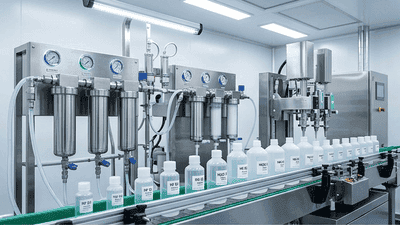
China’s progress in high-purity wet chemicals therefore deserves attention beyond the usual localization headlines. The important development is not simply that domestic suppliers can produce cleaner acids and bases. It is that selected products are moving through customer validation into accepted manufacturing use.
The distinction is fundamental. A laboratory result establishes a material property; qualification establishes whether a specific supply system can support a customer’s process. The G5 breakthrough becomes commercially meaningful when those two achievements converge.
What G5 Purity Actually Means
G5 is commonly used in the semiconductor materials industry to describe an exceptionally demanding purity tier for wet process chemicals. In the general grading framework often cited by Chinese suppliers, it corresponds to metallic impurity limits around 0.01 parts per billion, or 10 parts per trillion. For hydrogen peroxide, analytical guidance describing SEMI Grade 5 likewise identifies maximum concentrations of 10 parts per trillion for most specified trace elements.
That figure should not be interpreted as one universal specification covering every contaminant in every chemical. Requirements depend on the relevant chemical standard, its edition, and the customer’s purchasing specification. Particle limits and other acceptance criteria may require separate agreement.
Nor does G5 mean that an aqueous chemical must contain an almost perfectly pure active ingredient. Hydrofluoric acid or hydrogen peroxide can be supplied at a deliberately controlled concentration in ultrapure water. The essential distinction is between the intended formulation and unwanted contamination.
Counting “nines” in a purity claim therefore tells only part of the story. A fab needs to know which impurities were measured, their individual limits, the particle characteristics, the concentration tolerance, and how reliably those properties are maintained.
Why Wet Chemicals Have Such a Large Influence
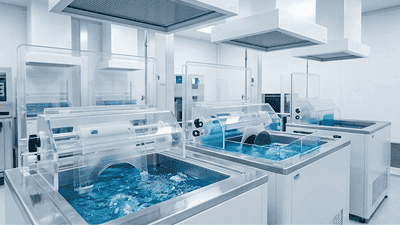
Wet chemicals touch wafers repeatedly during cleaning, etching, resist removal, and surface preparation. Their role is not merely to remove unwanted material. They must do so without leaving contamination or changing surfaces in ways that interfere with later steps.
Different contaminants create different risks. Metallic impurities can affect electrical behavior. Particles can become physical defects. Organic residues can compromise subsequent processing. Variations in concentration can alter removal rates, while changes in dissolved or suspended material can influence consistency.
The relationship is also process-specific. A chemical acceptable for one cleaning operation may be unsuitable for another. A customer making a relatively tolerant structure may impose different requirements from a customer processing a contamination-sensitive surface.
This is why G5 should not be treated as a guaranteed passport to a particular technology node. Very high purity is an enabling condition, not proof of universal suitability. Advanced manufacturing requires the right chemical, at the right concentration, with the right impurity profile, under the right operating conditions.
The Domestic Breakthrough Is Already More Than a Laboratory Claim
China’s domestic wet-chemical industry includes specialized purification companies, integrated chemical producers, and suppliers of formulated cleaning and etching products. Their capabilities differ considerably, making a single industry-wide claim of complete substitution misleading.
Hubei Xingfu Electronic Materials provides a concrete example of established progress. Its disclosures trace a G5 electronic-grade sulfuric acid breakthrough and stable production to 2020. Its company description distinguishes that sulfuric acid achievement from electronic-grade phosphoric acid, which it identifies under the chemical-specific SEMI C36 framework. This is a useful reminder that different products should not be forced into an identical grading narrative.
Xingfu’s 2025 annual report also described product certifications from major integrated-circuit manufacturers and stable supply of functional wet chemicals to multiple customers. The commercial significance lies in accepted products and sustained customer relationships, rather than the assumption that every chemical in its portfolio has identical purity or qualification status.
Progress remains uneven even within one supplier. Xingfu’s first-half 2025 disclosures, for example, described G5 ammonia solution as undergoing customer validation. That status was distinct from its established sulfuric acid production. A company can therefore have mature domestic substitution in one product and an unfinished qualification program in another.
Why Qualification Takes More Than a Certificate
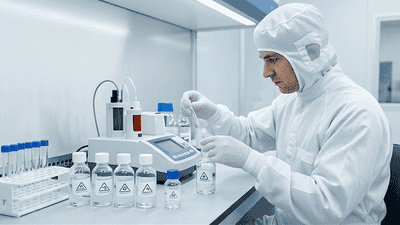
From the supplier’s perspective, a successful analytical test can feel like the finish line. From the fab’s perspective, it is the beginning of a risk assessment.
The customer must establish that the chemical performs acceptably in its own process. That evaluation can include incoming inspection, equipment compatibility, wafer tests, contamination monitoring, and comparisons against an existing material. The precise sequence varies by customer and application.
A trial must also reveal whether production remains stable over time. One acceptable batch does not demonstrate consistency across feedstock changes, maintenance events, packaging cycles, or different delivery conditions.
Supplier qualification consequently reaches beyond chemistry into quality management. Customers need traceability, documented change control, dependable corrective action, and confidence that an unapproved change will not quietly enter production.
For an analyst, this creates several distinct milestones: internal specification achievement, customer sampling, qualification completion, initial commercial delivery, and repeat supply. They should be recorded separately. Combining them into a single “breakthrough” can make progress appear more mature than it is.
Purification Is Only Half the Challenge
Reaching very low impurity concentrations requires an appropriate combination of feedstock selection, purification, separation, filtration, and contamination-controlled handling. The sequence depends on the chemical. A process suitable for one acid cannot simply be copied into a different solvent or oxidizer.
Distillation can remove certain impurities, but it does not solve every contamination problem. Filtration addresses particles, while dissolved impurities require other controls. Equipment materials and operating practices must prevent the purification system itself from becoming a contamination source.
Scale introduces another difficulty. Laboratory apparatus handles small quantities under closely supervised conditions. Commercial production adds storage, transfers, larger wetted surfaces, maintenance requirements, and repeated packaging operations.
The breakthrough is therefore not just producing an unusually clean sample. It is sustaining the required performance through an industrial process that delivers acceptable yield, output, and cost. That capability depends as much on disciplined operations as on the original purification technology.
The Container Can Undo the Chemistry
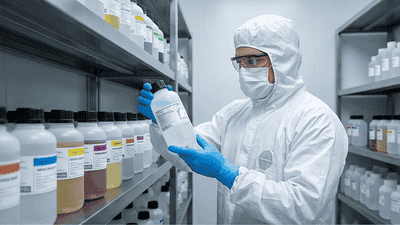
At parts-per-trillion impurity levels, packaging belongs inside the technical specification, not outside it. A liquid can leave the purification stage within limits and acquire contamination from a vessel, seal, valve, transfer line, or handling operation.
Material selection must account for compatibility, extractable impurities, particle generation, and cleaning effectiveness. Reusable containers introduce additional questions about return logistics, inspection, cleaning validation, and previous service history.
The importance of this step appears in domestic development programs. Xingfu’s 2025 interim report described electronic-grade packaging technology designed to meet the shipment requirements of G5 chemicals, including metallic impurity control below 10 parts per trillion. Packaging was being treated as part of the high-purity delivery system rather than a commodity accessory.
The practical lesson is straightforward: the product is not fully defined at the purification outlet. It is defined by what reaches the customer in usable condition. A credible supplier controls that entire journey.
Measurement Becomes a Competitive Capability
Very low contamination limits are meaningful only when measurement can support them. At G5 levels, the laboratory must distinguish contamination in the sample from contamination introduced during sampling, preparation, or analysis.
Inductively coupled plasma mass spectrometry is an important technique for measuring trace elements in semiconductor chemicals. Highly demanding matrices can require specialized methods to control interference and demonstrate reliable performance at very low concentrations.
But analytical capability involves more than owning an instrument. It includes method validation, clean sample handling, appropriate blanks, calibration, and a clear understanding of detection and quantification limits.
A result reported as “below detection” is not equivalent to zero contamination. Nor does it establish compliance if the measurement method cannot reliably resolve the purchasing limit.
For suppliers, a strong analytical laboratory supports both qualification and ongoing process control. For customers, transparent measurement practices make it easier to compare results and investigate discrepancies. This shared confidence can be as valuable as a marginal improvement in the headline purity number.
From High-Purity Inputs to Functional Formulations
Bulk electronic-grade chemicals and functional wet formulations are related but distinct businesses. A high-purity acid supplies a controlled chemical input. A formulated cleaner or etchant must also deliver a particular process outcome.
Customers may require selective removal of one material while preserving another, low corrosion, limited residue, or compatibility with increasingly complex structures. These requirements depend on formulation design as well as impurity control.
As domestic suppliers build purification capability, they gain a foundation for developing more specialized products. However, success in a bulk chemical does not automatically establish success in a proprietary blend.
Functional products can require closer collaboration with the customer and more application-specific testing. Their value may lie in selectivity, reliability, or reduced process complexity rather than simply a higher purity grade. The transition is attractive, but it introduces a different development burden.
Why Customers Want Local Alternatives
A qualified domestic supplier can offer shorter delivery routes, more accessible technical support, and greater flexibility during urgent troubleshooting. These advantages become especially useful when a fab is expanding or adjusting its process mix.
Local supply can also reduce dependence on a single overseas source. Yet geography alone does not establish resilience. A domestic producer may still depend on imported equipment, critical consumables, or a concentrated upstream feedstock source.
Customers therefore benefit from mapping the entire delivery system, including purification facilities, packaging operations, transport arrangements, and backup capacity. Two suppliers may appear independent while sharing an important upstream dependency.
The strongest localization strategy combines qualified alternatives with an understanding of those common risks. It seeks dependable supply under disruption, not merely a domestic address on an invoice.
The Economics Behind the Qualification Breakthrough
G5 capability can strengthen a supplier’s market position, but it does not guarantee high profitability. Purification, clean packaging, analytical testing, waste management, and customer support all carry costs.
New capacity can create a period of low utilization before qualification and commercial adoption catch up. Producing material that fails a demanding specification can also reduce effective output, even when the plant’s nominal capacity looks substantial.
Investors should therefore examine qualified sales rather than announced tonnage alone. Useful indicators include repeat orders, product-level revenue, acceptance consistency, utilization, cash generation, and the capital required to expand.
For customers, the cheapest quoted chemical is not necessarily the lowest-cost choice. Delivery reliability, process stability, and the consequences of contamination belong in the comparison. A small purchasing saving can be unattractive if it introduces a much larger manufacturing risk.
What the Breakthrough Really Changes
Domestic G5 wet-chemical progress signals a deeper manufacturing capability: the ability to purify, measure, package, and deliver sensitive materials under demanding customer controls. That capability is more valuable than a purity label standing alone.
The next stage will be measured by breadth and repetition. More qualified products, more accepted applications, consistent batch performance, and sustainable commercial supply will show whether individual achievements are becoming a durable industrial platform.
Wet chemicals rarely command the attention given to lithography or advanced packaging. Yet they interact with the wafer throughout manufacturing. The domestic qualification breakthrough matters because it strengthens that less visible foundation—one accepted product, controlled delivery, and repeatable process result at a time.