
Advanced Ceramic Components in Etch and Deposition: The <10% Localization Gap
A semiconductor equipment company can assemble a competitive etch or deposition platform while remaining dependent on overseas suppliers for several of its most important internal components. The chamber carries a domestic brand, the controls are developed locally, and the process has passed customer evaluation. Yet the ceramic parts exposed to plasma, heat, and demanding chemistry may still come from a narrowly qualified supplier base.

That distinction is the heart of the localization gap. Progress in complete equipment does not automatically establish equivalent capability in the materials and components that make the equipment reliable.
The “less than 10%” figure in the title is treated here as a scenario for selected high-specification ceramic categories, not as a verified China-wide market statistic. No sufficiently defined basis establishes it across all semiconductor ceramics. The broader issue is nevertheless clear: qualification, rather than production volume alone, determines whether local components become usable manufacturing supply.
The Percentage Needs a Product Boundary
A localization rate means little without explaining what it measures. Purchasing value, unit count, installed components, and qualified product categories can produce very different percentages.
A supplier might deliver many simple ceramic parts while having little presence in high-value functional assemblies. Another might qualify a small number of complex products that represent a substantial share of spending.
The geographic definition matters too. Local machining of an imported ceramic blank is different from local powder preparation, forming, sintering, finishing, and functional integration.
For buyers and investors, the right starting point is a defined product list and manufacturing boundary. Otherwise, a low localization figure can exaggerate dependence, while a high one can conceal important upstream vulnerabilities.
Why Etch and Deposition Put Ceramics Under Pressure
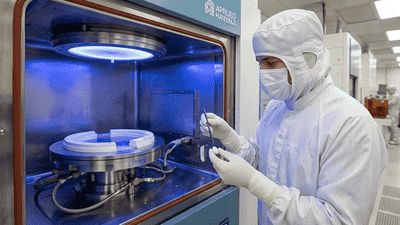
Etch and deposition equipment creates controlled environments in which chemistry, energy, pressure, and temperature produce the desired change on a wafer. Internal components must tolerate that environment without becoming an unacceptable source of contamination or variation.
Plasma exposure can erode chamber components and release material that affects manufacturing. Research on yttria coatings specifically identifies particle contamination from internal ceramic components as a process concern, illustrating why resistance and surface behavior matter.
The practical consequence is that a ceramic part is not simply structural hardware. Its behavior can influence chamber cleanliness, maintenance intervals, and process consistency.
From a fab engineer’s perspective, a replacement is acceptable only if it preserves the operating conditions required by the process. A matching drawing does not establish equivalent performance.
The Ceramic Component Market Is Several Markets
The term “advanced ceramics” includes a broad set of materials and product types. Chamber liners, rings, insulators, gas-distribution components, wafer-support assemblies, and heaters can involve very different requirements.
Some parts rely mainly on dimensional precision and material purity. Others must provide controlled electrical or thermal behavior. Still others combine a structural substrate with a protective surface coating.
That diversity makes blanket substitution claims unreliable. A company that successfully manufactures one component family may still need substantial development before entering another.
For a localization program, the sensible approach is to map capabilities by application. Material preparation, machining, coating, assembly, and testing should be evaluated separately before assuming that success in one area transfers automatically to the rest.
Material Selection Is Only the First Decision
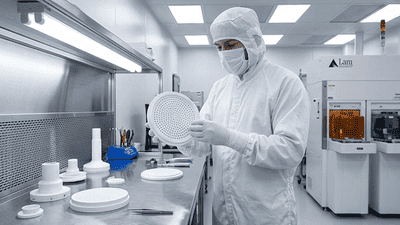
Alumina, aluminum nitride, and yttria appear frequently in semiconductor equipment discussions, but the material name does not fully describe the finished component.
Purity, density, microstructure, additives, surface condition, and processing history can influence performance. The appropriate balance depends on the application rather than a universal ranking of materials.
Aluminum nitride can be useful where thermal and electrical properties are important. Alumina serves many structural and insulating roles. Yttria-based surfaces are used where resistance to particular plasma environments is valuable.
For an emerging supplier, acquiring the right powder is therefore not the same as acquiring the necessary manufacturing capability. The finished product must preserve the relevant properties through forming, thermal processing, machining, cleaning, and delivery.
Coatings Can Bridge Capabilities—but Add Their Own Risks
A protective coating can combine the useful properties of a substrate with a surface better suited to the process environment. This can be more practical than manufacturing an entire large component from the protective material.
However, coating quality depends on more than composition. Porosity, adhesion, thickness, surface finish, and coverage can influence behavior under operating conditions.
A coating that performs well on a simple test sample may behave differently near holes, edges, or complex transitions. The actual geometry matters.
From a manufacturing perspective, localization must therefore include coating application and verification, not merely powder supply. From a customer perspective, the acceptance criteria should describe the finished surface and its performance rather than rely exclusively on nominal material purity.
Machining Precision Can Conceal Surface Damage

A ceramic component may meet dimensional specifications while carrying surface or subsurface damage that affects its useful life. The finishing process is therefore part of functional performance.
Complex geometries can make manufacturing especially demanding. Thin sections, intricate passages, and tight tolerances require control that goes beyond general-purpose ceramic fabrication.
For a supplier, this creates a yield problem as well as a precision problem. A part can accumulate considerable processing cost before a final defect makes it unacceptable.
For an investor, nominal factory capacity should be distinguished from accepted output. Expansion creates commercial value when it increases the quantity of parts customers can use—not simply the number entering production.
Functional Assemblies Raise the Barrier Further
Electrostatic chucks and ceramic heaters illustrate the difference between a ceramic body and a functional assembly. Their performance depends on integrated structures and their interaction with the surrounding equipment.
A chuck must provide the intended wafer-support behavior. A heater must establish the required thermal conditions. Both may need to operate across repeated cycles in a demanding chamber environment.
This adds electrical and thermal verification to material and dimensional inspection. It also increases the importance of integration with equipment controls, mounting arrangements, and other subsystems.
For localization, the implication is clear: success in passive ceramic parts does not automatically establish readiness for these assemblies. The development path needs additional engineering, testing, and customer collaboration.
Qualification Is a Production Experiment, Not a Paper Exercise
Customer approval usually requires evidence connected to the intended application. Depending on the component, that can include inspection, representative exposure, process trials, and monitoring over an operating interval.
The objective is to establish whether the replacement maintains acceptable performance and whether its behavior remains predictable.
A short trial may reveal obvious problems but miss issues associated with repeated use, cleaning, or gradual wear. Qualification scope therefore needs to reflect the risk being managed.
From a supplier’s perspective, a narrow approval is still valuable. A component qualified for one chamber and process can become a foundation for expansion. It should not be presented as universal acceptance across equipment platforms.
Why Equipment Localization Can Advance Faster
An equipment developer can combine locally developed subsystems with qualified imported components to create a commercially usable platform. That allows progress in the complete machine even while some component capabilities remain external.
This is a practical development route, not an inconsistency. The customer’s immediate priority is an operating system.
However, it creates a second phase of work. Replacing a critical imported ceramic can require revisiting process behavior that was originally established around that component.
The localization gap is therefore partly a sequencing issue. Complete-tool development can establish demand and operating experience, while component substitution proceeds more gradually. The important question is whether that second phase is producing qualified alternatives rather than only ambitious targets.
Mature Processes Offer Entry Points, Not Easy Passes
Established processes can provide manageable opportunities for local ceramic suppliers. Requirements may be well characterized, and customers may be able to evaluate replacements within clearly defined boundaries.
Nevertheless, mature-node manufacturing still requires dependable quality. Analog, power, memory, and other products can have demanding reliability requirements even without the smallest transistor dimensions.
The advantage is not an absence of technical difficulty. It is the possibility of focusing development on a specific, understood application.
A supplier that succeeds there gains production feedback, service experience, and credibility. Those assets can support further development, but adjacent applications still need their own evidence.
The Back-End Connection Is Selective
Ceramic dependence in etch and deposition is principally a wafer-processing equipment issue. Advanced packaging can also use related processes, along with ceramic substrates, thermal structures, and specialized support components.
The requirements are not identical. Packaging applications may emphasize interfaces, joining compatibility, electrical insulation, or heat dissipation rather than resistance to the same chamber environment.
For suppliers, shared material expertise can be useful, but it does not eliminate application-specific development.
For analysts, front-end and back-end opportunities should remain distinct. A company’s progress in packaging substrates is not direct proof that it can replace a plasma-facing chamber component, and the reverse is equally true.
Local Support Can Create Value Before Full Independence
Nearby engineering teams, inventory, cleaning services, and repair capability can improve responsiveness even when some upstream inputs remain imported.
These contributions should be recognized without overstating what they achieve. Faster troubleshooting is different from independent powder supply. Local refurbishment is different from manufacturing a new functional assembly.
A realistic strategy identifies which capability addresses the immediate risk and which additional capabilities are needed over time.
For customers, this can be more useful than insisting on complete localization before engaging a supplier. For providers, it creates a staged commercial path in which service and manufacturing capability develop together.
The Economics Must Reward Consistency
Price discounts can encourage evaluation, but they cannot compensate indefinitely for unreliable performance. Customers assess component life, process stability, maintenance demands, and the consequences of failure.
A low-cost part can become expensive if it shortens service intervals or creates additional investigation. Conversely, a qualified alternative can reduce total cost and improve purchasing flexibility.
For emerging suppliers, pricing must support the quality systems required for growth. Inspection, process development, traceability, and field support are not optional overheads in this market.
The strongest proposition combines dependable performance with competitive lifetime economics. That is more durable than relying on low acquisition prices or policy-driven purchasing alone.
A Practical Route to Closing the Gap
Progress becomes measurable when it is organized around capabilities and customer outcomes.
- Define the component categories and the localization measurement basis.
- Stabilize material quality and manufacturing yields for existing products.
- Develop inspection methods tied to functional requirements.
- Qualify replacements in specific chamber and process applications.
- Build traceability and service support around repeat deliveries.
- Expand into adjacent products only when the underlying capabilities are demonstrated.
- Reduce critical upstream dependencies without compromising accepted output.
This approach does not promise rapid replacement everywhere. It creates a credible sequence in which each step strengthens the next.
What Buyers and Investors Should Watch
The most useful indicators are repeat orders, broader qualified product lists, stable manufacturing yields, and consistent performance across multiple production lots.
Customer concentration matters too. One successful partnership can establish credibility, but broader adoption provides stronger evidence that the business is reproducible.
Revenue growth needs interpretation. It may reflect a single project, additional low-value products, or genuine progress into more demanding applications.
The strongest evidence combines commercial expansion with improving quality, useful life, and support capability. That is how a component supplier moves from promising participation toward meaningful production responsibility.
The Gap Closes in the Chamber
Advanced ceramic localization is not completed when a component is manufactured locally. It is completed for a particular application when that component performs reliably in the customer’s process and can be supplied consistently.
The less-than-10% scenario highlights the potential scale of selected dependencies, but the percentage is not the engineering objective. The objective is a dependable alternative.
Across etch, deposition, and relevant packaging applications, the winners will be suppliers that convert materials expertise into accepted operating performance. Localization becomes strategically valuable when the process keeps running—and customers are confident enough to order again.